
3rd August 2023 • My Family Our Needs
In this honest video interview and Q&A, Lucy Buxton of LJB Young People’s Coaching shares her personal journey, and offers advice for parents supporting their young person’s mental health.
Trigger warning, this video makes reference to self-harm and suicide.
Can you tell me a bit about how you are currently supporting young people?
At LJB Young People’s Coaching we support and inspire young people (13-23 year-olds) to grow. We help young people unlock their full potential and we do this by working in partnership with the young person and their family. We use a coaching process that helps create forward movement. Young people come to us when they are finding life hard. It could be that it’s exam stress or challenges within relationships. We listen and teach them how to move forward so that they can navigate the challenges that life presents. We work with young people over Zoom or face-to-face depending on where they live. You can find out more about us here.
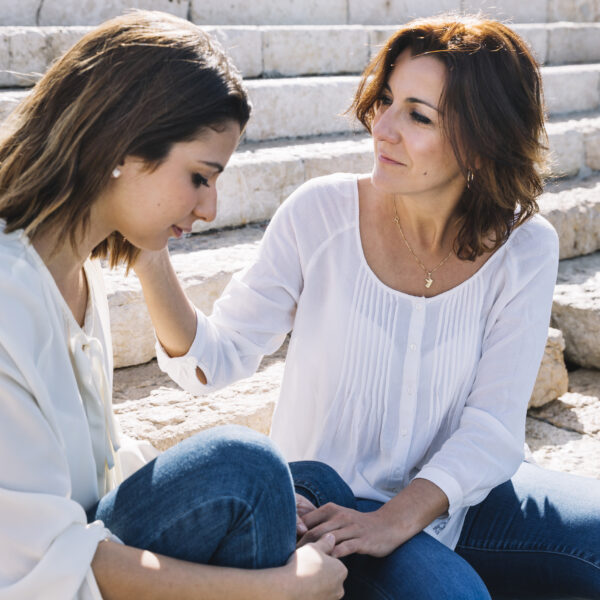
How do you initiate a challenging conversation with a young person if you are concerned about their mental health?
When a young person is not in a good place with their mental health, often the hardest thing for them is to acknowledge externally how they feel. They will be experiencing many emotions, and often these can be conflicting. Potentially they will believe things about themselves that are not true, such as: I’m not good enough and there’s no one to talk to. They might be embarrassed or just don’t want to be a burden especially if the adult nearest to them is finding life challenging. I often find the best way to start a conversation is just to let them know that you are there for them, ready to listen with no judgement. Sometimes we can ask someone how they are and they can say they are fine yet we don’t believe that’s the case. In those cases, it’s important to ask again and to let them know there is help. Give them options and choices. For example, say that if they don’t want to talk to you, you will help find them someone that they can talk to. Tell them if it’s easier to drop you a text or to write it down.
When you discovered your daughter was self-harming, how did you manage the situation? Now, drawing on your own experience, what advice would you give other parents?
I didn’t know that my daughter was self-harming. She had managed to hide it for around 12 months. I discovered it when she was in hospital. At first, I didn’t say anything. I carried on like it wasn’t a thing. I waited my time and was then able to ask her a couple of questions and I gave her the option to not talk if she didn’t want to. I knew she had to be ready to share her experiences and feelings with me. For us, it was within the following 24 hours, she couldn’t hide it anymore. She was able to tell me that it was a relief that I knew and that she didn’t have to hide anymore. The guilt of lying was making her self-harming worse; and the stress of the fear of what people might think ended up as a vicious cycle that was broken by openness and honesty.
For parents that find out their child is self-harming, firstly park your emotions. It’s may not be about how good you are as a parent, how supportive you are for example. It’s a strategy some people use to cope with intense thoughts and emotions that they are not able to hold, process, and let go of. Listen without judgement. Ask what they need. Educate yourself and then ensure that you have a plan. This is very important as some forms of self-harm can be very dangerous. If you have a mental health professional supporting you, talk to them. If not speak to your child’s GP. As a parent, find a place to process your emotions. I went to a counsellor for nine months because I needed a place to put my thoughts and feelings so that they didn’t overwhelm me. Most of all, don’t hide it. Respect your child’s privacy yet don’t be ashamed of what they are doing.
There is a health and safety element to be aware of. It may be that you have to remove some objects from your home. It’s also about ensuring there are no follow-on complications such as wound infections which can be very dangerous. Approach it like a physical problem e.g. a broken leg. Stay calm, assess the situation, and use the safe plan that you have established.
How can you support your young person’s education during a time of crisis?
I think this is less easy to answer because it’s about personal belief. For me, education was the last of a very long list of priorities and I knew that when my daughter was ready to engage in education she would.
Firstly, any dreams that you hold as a parent for your child being a straight-A student, throw that out of the window. It’s not about you, it’s about your child. Ask them what they want. Find out what they feel they can cope with. If they are attending school, talk to the school about what support they can give. If there are problems at school find out how the school are going to help. It may be that the school nurse can be of some support. Consider your options. For my daughter, education was focused on drawing and learning new skills. Eventually, she undertook home-schooling and interest-led learning. We crocheted, cooked, knitted, drew, and found a love with gardening. This gave her the space to grow in her way and on her time. She has recently taken English and Maths GCSE at 19. Know that not everything in life has to go according to ‘the norm’ of an education system.
How can parents best protect their own mental health and wellbeing whilst supporting their child through difficult times?
I mentioned previously that I saw a counsellor for nine months, every week. It wasn’t that I needed counselling per se, I just needed to put all of my thoughts and feelings about the situation somewhere. I needed a safe space and I realised very early on as a single parent that I was important and that if I didn’t look after myself, there was no way I could effectively advocate for my daughter. Self-care is key. I knew who I could talk to and they respected my boundaries and choices as to whether I wanted to talk. Some parents want to understand, I know I did. So I educated myself very quickly. I trusted what I felt and knew as a Mom and I stood up for what I believed in. I do understand that some parents may not want to understand or may not be ready to, they may also not be able to advocate, so it’s essential that support is found. This may be as I’ve mentioned previously by way of a mental health practitioner or a social worker. After my daughter came home from hospital, the social worker was a great support and they supported me by giving me time out. I learned to take each day at a time and over time things got easier. Finding another parent that has been where you are may be of benefit, as understanding is different to empathy.
If your young person is a teenager/young adult, how do you support their independence whilst protecting their vulnerabilities?
Here there are two things to think about: healthy boundaries and effective communication. As people, healthy boundaries and the communication of them, are a key aspect with regards to harmony in relationships. So for example, if a young person wants to be in their bedroom, and the parent is concerned about this, it’s about having calm conversations and agreeing to the young person being in their room as long as the bedroom door is kept open. It’s all about explaining things calmly to educate everyone in the situation. Friction often comes from not understanding what another person needs or wants. I knock on both my son and daughter’s bedroom door yet they know that if they don’t answer I will go in slowly. Both parties have feelings and thoughts, yet there has to be respect for each other. When it comes to things like internet safety, it’s about having honest conversations about the risks and also giving choice. If parents pay for the mobile phone or internet there are apps and security settings that can be used to reduce the risk of harm whilst being on the internet – yet these measures and their use should be communicated. They should not be used as a punishment, just a way to ensure safety. Sometimes we have to let our young people do stuff and as parents, just have to be ready to help them pick the pieces up without judgement.
Any other coping mechanisms, practical tips, advice you can offer parents?
It’s that old saying ‘you can’t pour from an empty cup’. As parents or guardians, we need to look after ourselves. Rest when you can, ensure that you are eating and drinking properly and get sleep. If you are not feeling well, speak to your GP. Educate yourself. For me, education around The Mental Health Act was key and also about the conditions that my daughter potentially had. Find some support. You need a scaffolding around you. When it comes to the mental and physical health of your child, make a note of small changes, don’t obsess about them yet, note if they are sleeping more, refusing meals, or getting bad reports from school for example. Normalise open and honest conversations and ensure there is no judgement. This can start from a really young age. If a child asks questions don’t lie, kids know when you are lying. Also, educate yourself and your child about mental wellbeing. Offer transparency as an option, yet don’t try and enforce it. Young people need to feel safe to be able to open up and embrace who they are. We all have choices and with choices comes responsibility. Sometimes these choices also come with consequences both positive and negative. Having healthy, open conversations around such topics can help.
Lucy Buxton is a qualified nurse and has worked in the NHS and social care for 33 years. She is also a trainer of Neuro Linguistic programming, a trainer of hypnotherapy and time line techniques as well as being a coach. She spends her time coaching leaders in social care and young people. Through her own journey and as a Mum, she combines her personal knowledge and professional experience to help young people unlock their full potential. You can contact Lucy via her website – https://ljbyoungpeoplescoaching.co.uk/, via her Facebook page or Linkedin.