
6th December 2023 • My Family Our Needs
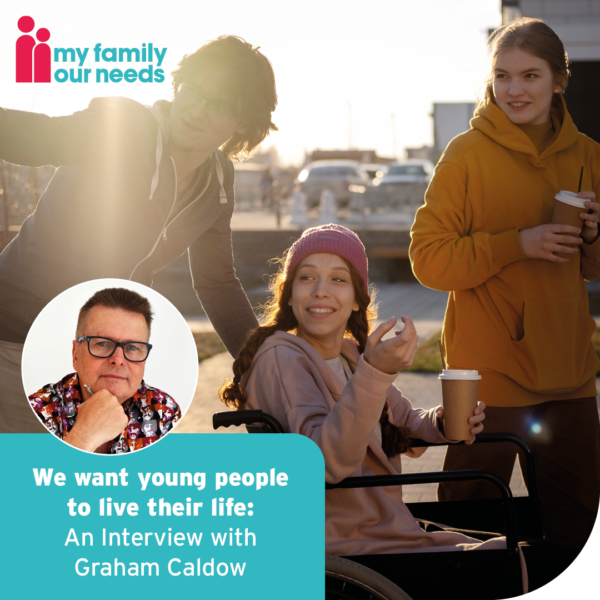
In this interview, we introduce Graham Caldow, author of What’s Possible and the father of a daughter with additional needs.
We asked Graham about his brand-new book and what it takes to create a life plan for your child with additional needs. He spoke to us about working with your child to build relationships, manage finances, find purpose and live independently.
Tell me about how parents can foster financial independence in their young people.
Parents need to think about financial separation. Once we think about that, we can think about how well our child will be able to manage their money and if they need support. At one end of the continuum is being able to do that fully, at the other end is a guardianship where someone else has control. Options in the middle may include a trust that will provide financial security. Once we decide where our young person fits on that continuum, we can think about how we’re going to organise their finances so it works in the future for when we’re not around.
One day, my daughter is going to have to live without me and I want financial security for her so she can live and maintain her life. My daughter’s finances are separate from mine. I want my daughter to start living now when she’s in her twenties, not when I’m gone. It’s about living her best life and feeling that she’s is in control of her own life.
So for her it comes down to tracking spending. Most people don’t follow a budget because it’s hard. But tracking spending is easier and banking apps help do this very well. My daughter uses a banking app and transfers her spending each week to a spreadsheet. Then, at the end of the month, she can see where she spends her money. She has one account for her daily living expenses like going out with friends and travel, and other accounts for things she needs like clothes and personal items, as well as a savings account. She also pays us a nominal amount for rent. We often talk to her about delayed gratification. It’s not so much to stop her spending money, it’s more to make her think about whether she would get better value by spending it elsewhere.
What did the first conversation to set up a money management plan look like?
We did it one step at a time. It takes time for everyone to learn to track their spending and learn to manage their money. Any child’s life plan should include ownership over their money with their input because it’s their life. It needs to be a conversation. Initially, my daughter had one bank account, then some money was transferred for her weekly spending, and then we introduced the clothes budget and set up the spreadsheet. It came in slowly. She’s just coming on 22 so I’ve probably been at this a bit longer than other parents.
Have you ever spoken about long-term financial goals?
Our goals are both short-term and long-term. We designed our house with her in mind and we use a lot of smart technology around the house. When it comes to long-term goals, she knows she’s going to live in this house. She’s working on getting her finances in control, which she’s doing consistently, but it’s a work in progress. She’s doing very well at it, but she doesn’t necessarily think 10 or 20 years into the future.
‘We want young people to live their life in their own way and not just be dependent on others including us‘
Tell me about how parents can encourage their young people to build strong, healthy relationships.
Often communication is an issue so my daughter might talk to her friends in a different way than her older sister does who can communicate articulately with more complexity. For example, my youngest daughter went out with a friend recently but when we asked how her friend was doing, she didn’t really know. So we as parents have to talk to our young people and try and explain how relationships work. It’s a learning curve.
One practical thing parents can do is to practice scripts with their child because these act like conversation starters that should lead on to two-way conversations. Often, young people with additional needs don’t know what questions they should be asking. It’s something my daughter is learning but I think it’s useful to think about how scripts and social stories can help to explain how other people feel.
The other thing we as parents don’t often think about is that their relationship with us has to change. If you have a child with additional needs, you end up doing a lot for them but you still have to allow the space for them to grow and become more independent in your relationship.
Has your daughter ever had any situations of bullying or rejection?
Unfortunately, we’ve had bullying, I think every family has at some point. We had one of her friends ask her to a party, but clearly the parents didn’t want her to come so a written invitation never appeared. Rejection like that happens sometimes. On the one hand, you’re feeling angry but on the other hand, you’ve got to focus on your child to support them, boost their ego and make sure their self-worth isn’t affected.
Tell me about how parents can help their young person develop skills to live independently.
To live independently requires daily living skills. When children are younger, it’s a matter of using techniques like scaffolding to teach them these skills. If we do everything for them, they won’t learn these skills.
My daughter travels independently which allows her to meet up with friends. She probably isn’t going to drive, so buses and trains are essential. She has go-to rules to follow when crossing roads. She also likes technology and she’s good with her phone. Working the bus app was easy for her. Technology even makes shopping easier. She uses her phone to pay and we use a shopping list app. In the kitchen, we’ve got gadgets like an air fryer, microwave and a pizza oven to make things easier for her.
My daughter has a job so she has a list of things to do related to that, which includes washing her work clothes, hanging them out to dry, ironing them, and cleaning her shoes once a week.
‘Parents can encourage a good attitude‘
What did the transition process of handing over responsibilities look like?
Some of these things just happened so naturally and slowly that we didn’t really think about it. With shopping, she started pushing the trolley when she was young and over time, we gradually stepped back and asked her to get things she needed and pay herself at the self-checkout. We’ve now got to the stage where she has a list and going to the supermarket isn’t an issue for her. It just evolved over time using the scaffolding approach.
My daughter wants to be independent. There’s lots of things you can do with modern tech to make the transition easier. I suppose we have the mindset that we want young people to live their life in their own way and not just be dependent on others including us.
Talk to me about your daughter’s career journey.
Her career ended up being something that we never imagined in all honesty. When she was at school, we presumed she would get a job. You have to presume your young person is going to get a job because if you don’t, you don’t engender that belief in them. It has to come from you. It’s not good for anyone’s mental health to be at home all the time with no purpose to the day, so we found a supported internship. We assumed she was going to do something with minimal people contact, but she loved Front of House during work experience. The supported internship was fantastic and when the programme finished she got a job as a Food and Beverage Assistant at a hotel.
I don’t think my daughter is quite ready to work full-time so it’s a case of getting skilled in doing her job, then gradually increasing the hours. She does have an inclusive employer that is prepared to make reasonable adjustments. I’m hoping they’re in this for the long term as she is very reliable. In hospitality there is a quick turnover of staff, but once she learns her role, she’s not going to want to change jobs every year, which is something she can offer an employer.
I think it’s important to remember there are two parts to a job – there’s doing the job and the attitude towards it. The little things like turning up on time, being ready to work and not getting distracted. Parents can encourage a good attitude. It’s something that can be taught.
‘I’m going to have a good life, this is what I’m going to do and this is how my life’s going to look‘
How do you encourage and inspire your daughter’s passions?
My daughter is really interested in music and drawing and we’ve always encouraged her to carry on with this. We’ve always thought about building up a community of different relationships from friendships to possibly one day a romantic relationship. She goes to a weekly kickboxing club, where she meets friends, and we try to get her involved in our community. We try and encourage her interests like music and she’s recently got a gig buddy to go to live music with.
Is there anything else you’d like to add?
When we thought about what is going to happen to our daughter when we’re not around, we decided to think in a more positive way and ask, how can she really start living her own life? We knew we needed a life plan that covers daily living, relationships, purpose and financial security. We needed to get that all together and have a vision of how her life is going to be. But we had to talk to her about that because it had to be her plan. When we don’t have a plan, our children with additional needs can’t picture where their life is going and so they can’t think, I’m going to have a good life, this is what I’m going to do and this is how my life’s going to look.

Graham Caldow lives with his wife Debra in the South of England and is the father of two daughters. Having run various businesses for over 20 years, Graham now dedicates his time to supporting parents to help their children build the skills they need to live the life they want. Through Red Giraffe Solutions, he helps parents of children and young adults with additional needs answer the question: “What’s next for my child?”. As the parent of a young adult with additional needs himself, his ultimate goal is to ensure they are financially secure, independent and fulfilled through bespoke life plans covering topics such as finances, building relationships and living with purpose. In his new book What’s Possible? Plan a better life for your young adult with additional needs Graham shares his experience supporting his daughter and explains how he created simple models to create a personalised life plan to ensure a secure future.
Purchase the book here!