
11th August 2026 • My Family Our Needs
Do you suspect your child may have ADHD? Wondering what your diagnosis options are and what the Right to Choose pathway offers? In this ‘How to’ guide, we’ll explain what Right to Choose is, who can use it, how to ask your GP for a referral, and what to expect throughout the assessment process.
Contents
- What is Right to Choose?
- Can children get an ADHD assessment through Right to Choose?
- How to get an ADHD assessment via Right to Choose: step by step
- What to say to your GP about Right to Choose
- Which Right to Choose providers offer ADHD assessments?
- How long does a Right to Choose ADHD assessment take?
- What happens after an ADHD diagnosis?
- What if my GP says no?
- Things to know before choosing Right to Choose
- ADHD support while waiting for an assessment
- Final thoughts
- FAQs
If you’ve started wondering whether your child may have attention deficit hyperactivity disorder (ADHD), you’re not alone. Many parents spend months trying to understand why their child is struggling to focus, manage their emotions or cope with everyday demands. Taking the first step towards an assessment can feel overwhelming, especially when NHS waiting lists are long and it’s difficult to know where to begin.
Although many children are referred to their local NHS ADHD service, families living in England may have another option. Under the NHS Right to Choose scheme, your GP may be able to refer your child to a different NHS-funded provider rather than your local service. For some families, this can mean accessing an assessment sooner, although waiting times and eligibility vary depending on the provider.
If you’re at the beginning of your ADHD journey or are still deciding whether to pursue an assessment, you may find it helpful to visit our ADHD hub, where you’ll find information about recognising ADHD, diagnosis, education, family life and organisations that can support you. We also spoke to Henry Shelford, CEO and Co-Founder of ADHD UK, about recognising ADHD, navigating the diagnosis process and helping children thrive.
What is Right to Choose?
Right to Choose is an NHS scheme in England that gives patients the opportunity to choose where they receive certain NHS-funded healthcare services.
Instead of automatically being referred to your local ADHD assessment service, your GP may be able to refer your child to another NHS-funded provider that offers ADHD assessments. This can be particularly helpful in areas where local waiting lists are very long.
Although many parents use Right to Choose because they hope to reduce waiting times, it’s important to remember that it isn’t a fast-track service. Alternative providers often have waiting lists of their own, and these can change depending on demand.
The assessment itself remains NHS funded, so there is no charge for eligible patients. However, each provider has its own referral criteria, assessment process and age requirements, so it’s worth researching your options before speaking to your GP.
Can children get an ADHD assessment through Right to Choose?
In many cases, yes. However, eligibility depends on several factors, including your child’s age, where you live and which providers are currently accepting referrals.
Some Right to Choose providers assess both children and adults, while others only accept adult referrals. Providers may also have different age limits or referral criteria, so it’s important to check these before asking your GP to make a referral.
Generally, Right to Choose is available if:
- your GP practice is based in England
- your GP agrees that an ADHD assessment is clinically appropriate
- the provider accepts referrals for your child’s age group
- the provider holds an NHS contract for the service.
There are situations where Right to Choose may not apply. For example, it cannot usually be used if someone is already receiving specialist NHS mental health treatment for the same condition following an elective referral, is receiving certain secure services or is detained under the Mental Health Act.
If you’re unsure whether your child is eligible, your GP should be able to explain your options.
How to get an ADHD assessment via Right to Choose: step by step
If you’re considering using Right to Choose, breaking the process into smaller steps can make it feel much more manageable.
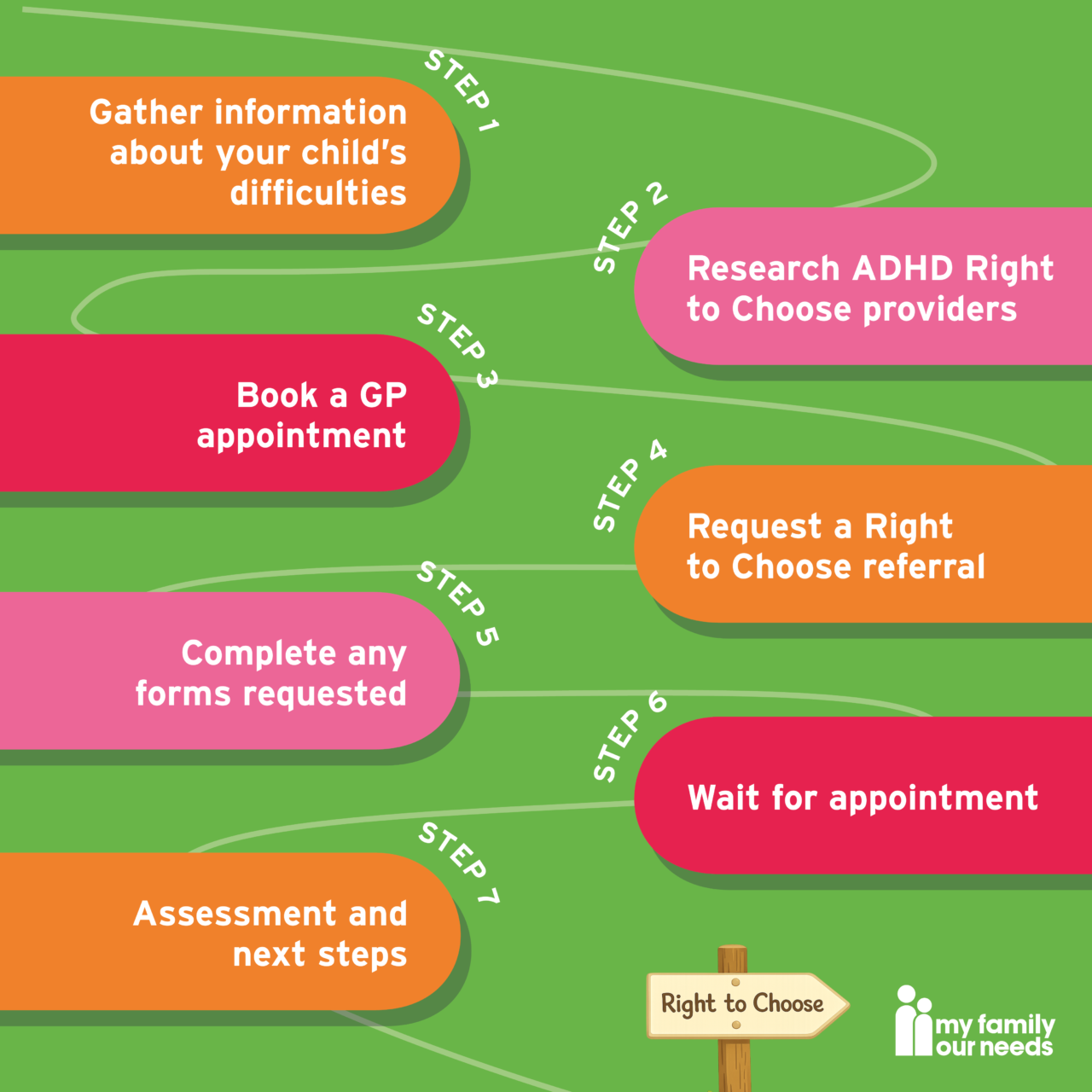
Step 1: Gather information about your child’s difficulties
Before booking an appointment with your GP, spend some time gathering examples of the behaviours and challenges you’ve noticed.
ADHD affects every child differently, but your GP will usually want to understand how your child’s difficulties affect more than one area of their life. This might include home, school or social situations.
It can be helpful to make notes about:
- difficulties with attention or concentration
- hyperactivity or constant movement
- impulsive behaviour
- emotional regulation
- organisation and memory
- sleep difficulties
- friendships and social interactions
- any concerns raised by school or nursery.
Try to include examples rather than general statements. Instead of saying your child “can’t concentrate”, explain what this looks like day to day.
For example:
“My daughter often forgets instructions within minutes, struggles to complete homework without constant reminders and becomes very distressed when routines change.”
If school has shared concerns, ask whether they can provide written observations or copies of reports. These can help build a fuller picture of your child’s needs.
If you’re new to Right to Choose, ADHD UK has a helpful guide explaining how the scheme works, who can use it and what the referral process looks like. It’s a good place to start before comparing providers.
Step 2: Research Right to Choose providers
Before asking for a referral, spend some time researching providers that currently accept Right to Choose ADHD referrals for children.
Things to consider include:
- whether they assess children and young people
- estimated waiting times
- whether assessments are carried out online or face-to-face
- what support they provide after diagnosis
- whether they accept referrals from your GP practice.
Remember that provider availability and waiting times can change regularly, so always check the latest information directly with the provider or NHS guidance.
Making a note of the provider you’d prefer before your GP appointment can help make the conversation much easier.
You may also find ADHD UK’s regularly updated Right to Choose waiting times page useful. It compares estimated waiting times for many providers, helping you make a more informed decision before speaking to your GP. Remember that waiting times can change, so always check directly with your chosen provider too.
Step 3: Book a GP appointment
Your GP is usually the first person you’ll need to speak to.
When you book your appointment, let the surgery know you’d like to discuss concerns about possible ADHD and ask about a Right to Choose referral.
During the appointment, your GP will want to understand your child’s development, behaviour and the impact their difficulties are having on daily life.
They may ask questions about:
- when you first noticed concerns
- whether symptoms occur in different settings
- your child’s medical history
- family history
- school performance
- emotional wellbeing.
Don’t worry if you don’t have every answer. Your GP isn’t expecting you to have diagnosed your child yourself—they simply need enough information to decide whether a referral is appropriate.
Step 4: Request a Right to Choose referral
If your GP agrees that an ADHD assessment is appropriate, you can ask whether they would refer your child through Right to Choose rather than to the local NHS service.
Some GPs are very familiar with Right to Choose, while others may have less experience with the process. If your GP isn’t sure, you can politely explain that you’d like to be considered for referral to an NHS-funded provider under your Right to Choose, if your child is eligible.
Having the provider’s name, referral information and any forms they require can make the process easier for both you and your GP.
Remember that your GP must still decide whether a referral is clinically appropriate. Right to Choose allows patients to choose an eligible provider, but it doesn’t remove the need for a GP referral.
If you’re unsure what Right to Choose options are available where you live, ADHD UK’s NHS Area lookup tool lets you search by postcode or NHS area to find local information about assessment pathways, waiting times and any local restrictions that may apply.
Step 5: Complete any forms requested
Once your referral has been accepted, you’ll usually be asked to complete questionnaires about your child’s behaviour and development.
These forms may be completed by:
- parents or carers
- teachers or school staff
- older children or young people themselves, depending on their age.
The provider may also request copies of school reports, previous assessments or other supporting information.
Although paperwork can feel time-consuming, it helps clinicians build a detailed understanding of your child’s strengths, challenges and how ADHD symptoms affect different parts of their life.
Try to complete forms as honestly as possible. There are no right or wrong answers, and it’s perfectly okay to describe both the things your child finds difficult and the things they do well.
Step 6: Wait for your assessment appointment
After receiving your paperwork, the provider will usually review the referral before offering an assessment appointment.
This stage is sometimes called triage.
Depending on the provider, they may contact you if they need additional information before confirming your appointment.
Waiting can still be difficult, even if you’ve chosen Right to Choose. While some providers have shorter waiting lists than local NHS services, demand continues to increase across England, and waiting times can change throughout the year.
If you haven’t heard anything after several weeks, it’s reasonable to contact the provider to check they’ve received your referral and ask whether they need any further information.
Step 7: The assessment and what happens next
ADHD assessments are designed to build a detailed picture of how your child thinks, behaves and functions across different settings.
The assessment may take place online or in person, depending on the provider.
A clinician will usually ask about your child’s development from an early age, current behaviour, education, emotional wellbeing and family history. They’ll often use recognised assessment tools alongside information from parents and school.
Some children receive a diagnosis following their assessment, while others may need further appointments or be found to have another condition that better explains their difficulties. It’s also common for clinicians to identify additional needs alongside ADHD, such as autism, anxiety or learning differences.
Whatever the outcome, the assessment should provide you with a clearer understanding of your child’s strengths, challenges and the support that may help them moving forward.
What to say to your GP about Right to Choose
Many parents worry about bringing up Right to Choose with their GP. You might feel like you’re asking for special treatment or that your GP won’t be familiar with the scheme. In reality, many GP practices regularly make Right to Choose referrals, and it’s perfectly reasonable to ask whether it’s an option for your child.
Try to approach the appointment as a conversation. Explain the difficulties your child is experiencing, how they’re affecting daily life, and why you’d like an assessment. If you’ve researched a provider, let your GP know which one you’re interested in and that they accept NHS Right to Choose referrals.
You could say something like:
“I’m believe my child may have ADHD and I’d like them to be assessed. I’ve been reading about the NHS Right to Choose scheme and understand that, if appropriate, they may be able to be referred to an NHS-funded provider rather than our local service. Would that be possible?”
If your GP isn’t familiar with Right to Choose, stay calm and ask whether they would be happy to look into it. Having details of your chosen provider, including any referral guidance or forms, can help make the process easier.
Which Right to Choose providers offer ADHD assessments?
The providers available through Right to Choose can change over time, and not every provider accepts referrals for children and young people. Some only assess adults, while others may pause referrals if demand becomes too high.
Before requesting a referral, check:
- whether the provider accepts children or young people
- the age range they assess
- whether they are currently accepting new Right to Choose referrals
- their estimated waiting times
- whether assessments are online, face-to-face or both
- what support they provide after diagnosis, including medication and follow-up care.
Many providers publish this information on their websites, along with referral forms and guidance for GPs.
Provider availability, referral criteria and waiting times can change, so always check the latest information with your chosen provider before asking your GP to make a referral.
How long does a Right to Choose ADHD assessment take?
This is one of the questions parents ask most often, but unfortunately there isn’t a simple answer.
Waiting times vary depending on the provider, the number of referrals they’re receiving and whether they currently have capacity to assess children.
Although many families choose Right to Choose because local NHS waiting lists can be several months or even years long, alternative providers can also have significant waits. Some may be able to offer appointments much sooner than local services, while others experience increased demand and longer delays.
It’s also worth remembering that the assessment itself is only one part of the journey. If your child receives a diagnosis, there may be further appointments to discuss treatment options, medication or ongoing support.
Checking providers’ published waiting times can give you an idea of what to expect, but these can change frequently.
What happens after an ADHD diagnosis?
Receiving a diagnosis can bring a mixture of emotions. For many families, it provides reassurance and helps explain behaviours that have caused concern for years. Others may need time to process the news and think about what happens next.
Following the assessment, you’ll usually receive a written report explaining the outcome and any recommendations. This may be shared with your GP and, with your agreement, your child’s school.
Depending on your child’s needs, the clinician may recommend:
- strategies to support attention, organisation and emotional regulation
- parenting programmes or behavioural support
- referrals to other professionals if appropriate
- medication, where clinically suitable
- follow-up appointments with the provider.
A diagnosis can also make it easier to access support in education. Schools have a duty to identify and support children with additional needs, whether or not they have a formal diagnosis. However, assessment reports can help schools better understand your child’s needs and consider what reasonable adjustments may help them succeed.
If your child’s needs are significant and affect their ability to access education, the assessment may also contribute to evidence for an Education, Health and Care Plan (EHCP) assessment.
Remember that an ADHD diagnosis doesn’t define your child. It’s simply one piece of information that can help you, your child and the professionals supporting them understand how they learn best.
What if my GP says no?
If your GP decides not to make a referral, it can feel incredibly frustrating, especially if you’ve already spent months trying to get support.
The first step is to ask why they don’t feel a referral is appropriate. There may be information they’re missing, or they may want further evidence from your child’s school before making a decision.
If you still disagree, you could:
- ask for the reasons to be explained clearly
- request a written explanation if appropriate
- gather additional evidence from school or other professionals
- arrange another appointment to discuss your concerns
- ask to see another GP within the practice for a second opinion.
If you believe your child meets the criteria for referral and you’re unable to resolve the issue with the practice, you can also speak to the practice manager or seek independent advice about the NHS complaints process.
Throughout this process, try to keep records of appointments, letters and any reports you’ve shared. Having everything in one place can make future conversations much easier.
Things to know before choosing Right to Choose
Right to Choose can be a valuable option for many families, but it’s important to understand how it works before making a decision.
Although it may offer a shorter route to assessment, it isn’t suitable for everyone and it doesn’t guarantee a quicker appointment.
It’s worth remembering that:
- Right to Choose is only available in England.
- Not all providers assess children and young people.
- Waiting times differ between providers and can change regularly.
- Referral criteria vary between services.
- Medication pathways and follow-up care may differ depending on the provider and local NHS arrangements.
- Your GP must still agree that a referral is clinically appropriate.
Taking a little time to research providers before your GP appointment can help you make a more informed choice.
ADHD support while waiting for an assessment
Whether your child is waiting through their local NHS service or a Right to Choose provider, the waiting period can be difficult.
Although it may be tempting to put everything on hold until you have a diagnosis, there are still plenty of ways to support your child in the meantime.
Speak to your child’s school about the difficulties they’re experiencing and ask what adjustments could be put in place now. Children don’t usually need a formal diagnosis to receive additional support in school, and small changes can sometimes make a big difference.
You may also find it helpful to:
- establish predictable routines at home
- break instructions into smaller steps
- use visual timetables or reminders
- praise effort as well as achievement
- learn more about ADHD from trusted organisations
- connect with local or online parent support groups.
Most importantly, remember that your child is much more than a waiting list or a diagnosis. Understanding their individual strengths, interests and personality is just as important as recognising the challenges they face.
You can also explore other ADHD articles and family resources here on My Family, Our Needs while you’re waiting for your assessment.
Final thoughts
Deciding to seek an ADHD assessment can feel like a daunting step, particularly when you’re already juggling school meetings, appointments and everyday family life.
While Right to Choose isn’t the right option for every family, it has helped many parents in England access NHS-funded assessments through alternative providers. Taking the time to understand how the process works, researching your options and preparing for conversations with your GP can help you feel more confident as you navigate the next steps.
Above all, remember that you’re not expected to have all the answers. Asking questions, seeking support and advocating for your child are all part of the journey. Whatever the outcome of the assessment, understanding your child’s needs is an important step towards helping them thrive.
Frequently asked questions
Can my child get an ADHD assessment through Right to Choose?
Many children and young people in England can access an ADHD assessment through Right to Choose, but eligibility depends on factors such as age, the provider’s criteria and whether your GP agrees that a referral is appropriate.
Is Right to Choose available everywhere in England?
Right to Choose is an NHS scheme for patients registered with a GP in England. However, the providers available and their referral criteria may differ, so it’s important to check current guidance.
Do I need a GP referral to use Right to Choose?
Yes. In most cases, your GP must agree that an ADHD assessment is clinically appropriate and make the referral on your behalf.
How long does a Right to Choose ADHD assessment take?
Waiting times vary considerably between providers and can change throughout the year. Although some families are seen more quickly than through their local NHS service, there is no guaranteed timeframe.
Can schools refer my child for an ADHD assessment?
Schools can provide valuable evidence about your child’s behaviour and learning, but referrals for NHS ADHD assessments are usually made through your GP or another healthcare professional.
Is Right to Choose free?
Yes. If your child is eligible and referred through the NHS Right to Choose scheme, the assessment is NHS funded.
Can I choose any ADHD provider?
No. You can only choose providers that offer the relevant NHS-funded service, meet the Right to Choose requirements and are accepting referrals for your child’s age group at the time.
Further information
- NHS – ADHD in children and young people – Information about ADHD symptoms, diagnosis, treatment and support for children and young people.
- NHS – Your choices in the NHS – Explains your rights to choose where you receive certain NHS services, including outpatient care in England.
- GOV.UK – NHS Choice Framework – Government guidance explaining patients’ rights under the NHS Choice Framework in England.
- NICE Guideline NG87: Attention deficit hyperactivity disorder – National guidance covering the recognition, diagnosis and management of ADHD in children, young people and adults.
- ADHD UK – Right to Choose resources – Practical guidance on using Right to Choose, provider information and additional resources.
- ADHD UK – Right to Choose waiting times – Estimated waiting times for many Right to Choose providers (please note these can change regularly).