
16th June 2026 • Scott Maddox
If you’re worried that your child might have dyslexia, you’re not alone. Many families and individuals reach a point where they know something isn’t quite right but feel unsure where to turn next. In this complete guide, Mark Wilson explains your options clearly, so you can take the next step with confidence.
In this Guide:
- What is dyslexia?
- Signs it may be time to seek an assessment
- What is a dyslexia assessment?
- Why an assessment can help
- What to say to your child’s school
- Can schools arrange a dyslexia assessment?
- What if the school has no concerns?
- Who can carry out a formal dyslexia assessment?
- What to look for in a dyslexia assessor
- How to get a dyslexia assessment: your options
- Does a dyslexia assessment have to be in person?
- How to prepare for a dyslexia assessment
- How much does a dyslexia assessment cost?
- Dyslexia and co-occurring conditions
- Support while waiting for assessment
- What happens after a dyslexia assessment?
- Understanding standardised scores
- What if the assessment does not identify dyslexia?
- I have had a dyslexia report. Why is my child’s school saying they still need to check access arrangements?
- Getting support without a formal diagnosis
- Dyslexia assessment for adults
- Final thoughts
- FAQ’s
1. What is dyslexia?
If you search online for signs of dyslexia, you will find no shortage of lists. Reversing letters, reading slowly, difficulty with spelling, confusing similar words, losing your place on the page. These lists can be a helpful starting point, but they can also be misleading, and it is worth understanding why.
Dyslexia does not present the same way in every individual. At its core, dyslexia is a difficulty at the word level (with reading accuracy, spelling, and fluency) that is unexpected given the person’s overall ability and their opportunity to learn. That word, unexpected, is important. It is what distinguishes dyslexia from a more general learning difficulty. A child who is finding everything hard may have a range of needs. Dyslexia specifically is where word-level difficulty stands out against an otherwise broader picture of ability.
What that looks like in practice varies enormously from person to person. Some children do reverse letters, but many do not. Some read very slowly; others have worked hard to build speed but sacrifice accuracy along the way. Some spell phonetically in a way that is at least decodable; others show no consistent pattern at all. Some children struggle visibly from an early age; others cope reasonably well for years before the demands of school or work outpace their ability to compensate.
This is precisely why a checklist or screener will only ever take you so far. A checklist matches an individual against a fixed set of indicators. A formal assessment looks at the individual themselves, exploring their specific profile of strengths and difficulties in depth, and building a picture that no list could replicate.
If something feels wrong, trust that instinct. You do not need your child to tick every box on a list to seek further support or assessment. The presentation of dyslexia is as individual as the person who has it.
Dyslexia affects people across the full range of intellectual ability. It is not a reflection of intelligence, and it does not only affect children who are visibly struggling in school. Some individuals are highly able and find ways to compensate, masking their difficulties for years before the effort required becomes unsustainable.
2. Signs it may be time to seek an assessment
Many parents have a sense that something isn’t quite right long before anyone else raises a concern. That instinct is worth taking seriously. While every child develops at their own pace, there are some patterns that are worth exploring further with a qualified professional.
These include ongoing difficulties with reading or spelling that persist despite support and practice, slow progress that doesn’t seem to reflect the effort a child is putting in, and a noticeable gap between what a child can do verbally (holding conversations, telling stories, asking questions) and what they produce in written form. This mismatch between verbal ability and literacy skills is one of the more telling indicators of dyslexia specifically.
It is also worth paying attention to frustration, anxiety, or avoidance around reading and writing tasks. A child who is working very hard to keep up may show their difficulties through emotional responses rather than academic results. Additionally, a family history of dyslexia is worth noting, as there is a well-established genetic component to the condition.
None of these signs confirms a diagnosis on their own. What they do confirm is that a closer look is warranted.
3. What is a dyslexia assessment?
A dyslexia assessment is a structured evaluation carried out by a qualified professional. It looks at a range of skills including reading, spelling, writing speed, phonological processing, and working memory, building a detailed picture of how someone learns and where specific difficulties lie.
The outcome is a written report. This sets out the assessor’s findings, explains any areas of difficulty, and makes clear practical recommendations for support. A formal assessment is different from a screener or checklist.
A screener is a shorter structured tool that indicates whether dyslexia-type difficulties are likely to be present. It can be a useful first step and is often used by schools. However, a screener cannot provide a formal diagnosis and is unlikely to carry weight for purposes such as exam access arrangements or DSA applications. A full diagnostic assessment is a comprehensive evaluation carried out by a qualified and registered professional, resulting in a detailed report with scores, findings, and recommendations. It is the full assessment, not the screener, that opens doors to formal support and adjustments.
4. Why an assessment can help
For many families, the decision to pursue an assessment brings a mixture of hope and apprehension. It helps to be clear about what an assessment can genuinely offer.
Most fundamentally, it provides a thorough and evidenced understanding of how your child learns, beyond what a school observation or screener can offer. It identifies specific areas of strength alongside the areas where your child is finding things harder, and it explains why. That clarity matters enormously, both for the professionals supporting your child and for your child themselves. Many children who receive a formal assessment describe feeling relieved — not because of a label, but because they finally have an explanation for something they have been struggling with, often in silence.
A formal report also carries practical weight. It provides the evidence base for conversations with school, supports applications for exam access arrangements where appropriate, and can inform decisions about targeted support at home and in the classroom. For older children moving towards secondary school or examinations, this can make a very real difference. It can also support with DSA funding and workplace adjustments.
Perhaps most importantly, an assessment treats your child as an individual. It builds a picture of them specifically (their particular profile of strengths and difficulties) rather than measuring them against a checklist. That is the foundation for support that actually works.
5. What to say to your child’s school
If you have concerns about your child’s literacy or learning, it helps to go into any school conversation feeling prepared. Here are some useful starting points:
- “I’ve noticed my child is struggling with reading individual words accurately and consistently, not just understanding what they read, but actually decoding the words themselves. Can we discuss what support is currently in place?”
- “My child seems to find spelling particularly difficult, even words they have practised repeatedly. Has the school noticed this too?”
- “Who is the SENCo, and can I arrange a meeting with them to discuss my concerns formally?”
- “Has the school observed any difficulties with reading fluency, word recognition, or written work? Are there any records of concern I should be aware of?”
- “What assessment tools does the school use, and has my child been screened for dyslexia specifically?”
- “Is the school currently working through an Assess, Plan, Do, Review cycle for my child? If not, can we discuss starting that process?”
- “If the school is not able to arrange a formal assessment, can you advise on what other routes are available to us?”
You do not need to have all the answers before this conversation. The key is to open a dialogue, make your concerns known formally, and ensure they are recorded and acted upon. If you feel your concerns are not being taken seriously, you have the right to put them in writing to the SENCo or headteacher.
6. Can schools arrange a dyslexia assessment?
This is one of the most common questions families ask, and the honest answer is: it depends.
Some schools have access to staff with the qualifications to carry out a formal assessment. Others rely on the local authority’s educational psychology service, where availability and waiting times vary considerably. In some cases, where a school has built up sufficient evidence of concern over time, they may choose to buy in the services of an independent assessor directly. This is not common practice in every school, and it is not something families can necessarily request, but it is worth asking whether it is an option your school has available.
In many cases, however, a school may only be able to offer a screener. A screener is a shorter structured tool that can indicate whether dyslexia-type difficulties are present, but it falls well short of a full diagnostic assessment. It can be a useful starting point, but it cannot provide a formal diagnosis and may not carry weight for purposes such as exam access arrangements.
What matters most is that schools have a legal duty to identify and support children with special educational needs, regardless of whether a formal diagnosis is in place. If your child is struggling, you can speak to the school’s Special Educational Needs Coordinator (SENCo) about what support is currently available and what assessment routes might be possible.
7. What if the school has no concerns?
It is not uncommon for parents to feel that something is not quite right, even when a school has carried out a screener and reported no significant concerns. This can be a confusing and isolating experience, particularly when you are seeing difficulties at home that do not seem to be reflected in what the school is observing.
There are a number of reasons why this can happen. Screeners are a useful first step, but they have significant limitations. They are designed to flag likely difficulties across a broad population, and most operate as fixed computer-based tools. They work within a set algorithm that cannot flex or adapt to the individual in front of it. A screener can only identify what it has been programmed to look for, in the way it has been programmed to look for it. As a result, it can miss children who have developed strong compensatory strategies, particularly able children who have found ways to manage their word-level difficulties without those strategies being visible to others. A child may be performing adequately in class while quietly expending enormous effort to do so.
This is particularly relevant for children with high intellectual ability. A bright child may not appear to be struggling because their overall performance in school looks broadly acceptable. However, they may be significantly underperforming relative to their actual ability. The gap between what a child is capable of and what they are producing can be just as important as the raw level of attainment. A screener is unlikely to detect this kind of discrepancy, but a full diagnostic assessment is specifically designed to explore it.
It is also worth remembering that dyslexia presents differently in every individual. Some children are skilled at masking. Others may show difficulties more clearly at home, during reading practice, homework, or simply in their frustration and avoidance around written tasks, than they do in a busy classroom environment.
If the school has no concerns but has not yet begun an APDR cycle, it is worth asking directly why not. Where difficulties have been observed, even informally, the school should be assessing and responding to those concerns in a structured way. You have the right to ask what is being done and to request that your concerns are formally recorded.
If you remain concerned after a school screening has returned no significant findings, it is entirely reasonable to seek an independent assessment. You do not need the school’s permission to do so. An independent assessor will carry out a much more comprehensive evaluation than a screener can provide. A full diagnostic assessment looks at a wide range of skills in depth and is specifically designed to identify difficulties that shorter tools may not detect.
It is also worth documenting your concerns in writing, noting specific examples of difficulty at home, how long they have been present, and any patterns you have observed. This provides a useful record and can inform the assessment process.
Your instinct as a parent matters. If something does not feel right, you have every right to seek a clearer answer.
8. Who can carry out a formal dyslexia assessment?
Educational Psychologists (EPs) — either through the local authority or privately. EP assessments are comprehensive and can inform Education, Health and Care Plans (EHCPs).
Specialist teachers and assessors who are qualified to Level 7 in SpLD assessment and registered with a recognised professional body. The main registering bodies are PATOSS (the Professional Association of Teachers of Students with Specific Learning Difficulties), the British Dyslexia Association (BDA), and the Dyslexia Guild. Reports produced by assessors registered with any of these bodies are accepted for exam access arrangements, university Disabled Students’ Allowance (DSA), and many workplace purposes.
Chartered psychologists with an SpLD specialism, which is another route particularly relevant for adults or more complex presentations.
It is worth understanding the practical difference between an Educational Psychologist and a specialist teacher assessor, as parents are sometimes unsure which route is most appropriate.
Educational Psychologists hold a broader psychological training and can assess a wider range of needs. They are particularly well placed where a child’s needs are complex, where social, emotional, and mental health (SEMH) difficulties are part of the picture, or where an EHCP is being considered or reviewed. It is important to know, however, that EPs cannot diagnose ADHD or autism unless they hold specific additional training and qualifications in those areas. If ADHD or autism is suspected, a separate referral pathway will usually be needed.
Specialist teacher assessors are specifically trained in SpLD and go deeper on the literacy and cognitive profile that is central to a dyslexia assessment. For dyslexia specifically, a specialist teacher assessment is widely accepted across education, university, and employment settings. It is often a more accessible and cost-effective option for families seeking a focused literacy and cognitive profile. Privately commissioned EP assessments also tend to cost more than those carried out by specialist teacher assessors.
Neither route is inherently better than the other. The right choice depends on what you need the assessment to address and what doors you need the report to open.
An Educational Psychologist may be better placed where needs are more complex, where SEMH difficulties are part of the picture, or where an EHCP is being considered. For a focused dyslexia assessment, a specialist teacher assessor is a well-recognised and cost-effective option.
9. What to look for in a dyslexia assessor
Whether you are seeking assessment for a child or yourself, it is worth taking time to choose the right assessor. Look for:
- Registration with PATOSS, the British Dyslexia Association (BDA), or the Dyslexia Guild
- A Level 7 SpLD qualification
- A current practising certificate
- Clear information about what the assessment involves and what the report will cover
- Transparent pricing and turnaround times
- An assessor who communicates findings clearly and offers time to discuss results
Do not hesitate to ask questions before booking. A good assessor will welcome them.
A report produced by a suitably qualified and registered assessor is valid for life. It does not need to be repeated or updated, meaning the assessment is a one-time process that can continue to open doors in education, employment, and beyond for years to come.
10. How to get a dyslexia assessment: your options
Option 1: Through school or the local authority
The starting point for many families is a conversation with the school SENCo. They can share what the school has already observed, explain what support is in place, and discuss whether a referral for further assessment is appropriate.
Where a school has concerns about a child’s needs, they may refer to the local authority’s educational psychology service. It is important to understand, however, that many local authorities in England do not routinely commission formal dyslexia assessments through their EP service. This is because, under the SEND Code of Practice, support should be based on a child’s identified needs rather than on a specific diagnosis. As a result, some families are told that if they want a formal dyslexia assessment, they will need to fund this privately.
This can feel frustrating, and it raises an obvious question. If support can be provided without a diagnosis, why bother getting one?
The answer is that a formal assessment offers something school-based observation alone cannot. It provides the most comprehensive picture available of how your child processes, learns, and thinks across reading, spelling, memory, and processing speed. Importantly, dyslexia presents differently in every individual. Some children struggle visibly. Others find ways to compensate and appear to be managing adequately in school, even when the effort required is significant. A formal assessment can identify those hidden difficulties and explain why a child who seems to be coping may still be working much harder than their peers, often at a considerable cost to their confidence and wellbeing.
A formal report also carries real weight. It can support applications for exam access arrangements, university DSA funding, and workplace adjustments. It also gives families a clear evidenced starting point for conversations with schools and other professionals.
A formal dyslexia label is not a legal requirement for your child to receive support. Additionally, EP capacity and waiting times vary significantly across local authorities. If you feel your child’s needs are not being met, you have the right to request a statutory Education, Health and Care needs assessment from your local authority. This is a more formal process and carries specific timescales and legal rights.
Option 2: Independent specialist assessor
An independent assessment is arranged directly with a qualified assessor, outside of the school or local authority system. This route is self-funded, but it offers several real advantages. These include faster access, flexibility around location and timing, and a detailed report you can use across education, university, and employment settings.
When choosing an independent assessor, look for someone who is registered with PATOSS, the BDA, or the Dyslexia Guild. They should hold a Level 7 SpLD qualification and a current practising certificate. It is also worth asking about report turnaround times and whether the assessor offers a follow-up conversation to discuss findings.
Option 3: For adults
Adults seeking a dyslexia assessment have several routes available. Those in employment may be able to access assessment through an Access to Work referral. For adults outside of education or employment support schemes, an independent assessment with a qualified specialist is usually the most direct route. NHS provision for adult dyslexia assessment is very limited in most areas of England, so an independent assessor is often the most practical option.
11. Does a dyslexia assessment have to be in person?
Not necessarily. Remote assessment carried out via video call using screen-sharing and digital test materials is now a well-established and widely accepted option. Many qualified assessors offer both in-person and remote appointments, giving families and adults considerably more flexibility.
Remote assessment can be particularly useful where travel is difficult, where a suitable local assessor is not available, or where a child or adult is more comfortable in a familiar environment. For adults balancing work and family commitments, the flexibility of a remote appointment can make the process much more accessible.
It is worth asking any assessor you approach whether they offer remote appointments and what the process involves. A good assessor will take time to explain how the session works and ensure you feel prepared before the appointment takes place.
12. How to prepare for a dyslexia assessment
Getting the most from a dyslexia assessment is partly about preparation. There are a few practical steps worth taking beforehand, for both children and adults.
It is worth ensuring that a recent eye test has been carried out before the assessment takes place. Visual difficulties can affect reading, and it is important that these are considered and where necessary addressed separately. Similarly, if there are any concerns about hearing, a hearing test is worth arranging in advance. Undetected hearing difficulties can affect the development of phonological processing skills, which are central to a dyslexia assessment.
Gathering any existing paperwork beforehand is also helpful. This might include previous school reports, letters from teachers expressing concern, results of any screeners already carried out, or any previous assessments or reports. This background information provides useful context for the assessor and helps build a fuller picture from the outset.
For parents bringing a child to assessment, it can help to talk to them beforehand in an age-appropriate way. The assessment involves a range of tasks that may feel unfamiliar, and a child who understands broadly what to expect is likely to feel more settled and perform more naturally. There are no right or wrong answers in a dyslexia assessment and reassuring a child of this can make a real difference to how they engage on the day.
For adults, it is worth thinking about any areas of difficulty you want to make sure are explored, and noting any specific contexts where difficulties are most noticeable. A good assessor will ask about this, but having thought it through beforehand means nothing important gets missed.
Finally, think about whether there are any co-occurring difficulties you want to raise. If ADHD, autism, dyspraxia, or other areas of difficulty are part of the picture, mentioning this at the outset helps the assessor approach the assessment with the full context in mind.
13. How much does a dyslexia assessment cost?
Independent dyslexia assessments in England typically range from around £400 to £950, though costs vary considerably depending on the assessor’s qualifications, location, and the depth of the assessment. In some regions, particularly in and around London, costs at the higher end of that range are not uncommon. There is currently no routine NHS funding for dyslexia assessment in most parts of England, meaning most families will need to self-fund.
We recognise that this is a significant amount for many families. If cost is a barrier, it is always worth asking an assessor directly whether they offer payment plans or reduced rates in cases of financial hardship. Some do, and it is not an unreasonable question to raise.
It is also worth knowing that a small number of charitable bursaries exist specifically to help families who could not otherwise afford an assessment. The Helen Arkell Dyslexia Charity and the British Dyslexia Association are two organisations that have offered funding support of this kind. It is important to be aware, however, that bursaries of this nature are limited in availability and do carry waiting lists. They are worth exploring, but they are not a guaranteed or immediate solution.
It is also worth bearing in mind that a report produced by a suitably qualified and registered assessor is valid for life. Unlike some professional reports that require periodic renewal, a dyslexia assessment does not need to be repeated. Over time, that makes the initial investment considerably more reasonable than it might first appear, particularly when weighed against the doors it can open in education, employment, and beyond.
14. Dyslexia and co-occurring conditions
Dyslexia rarely occurs in isolation. Research consistently shows that it frequently co-occurs with other specific learning differences and developmental conditions including ADHD, autism, dyspraxia (also known as Developmental Coordination Disorder, or DCD), and dyscalculia.
A good dyslexia assessment will not only identify dyslexia but will also flag where other difficulties may be present. Where an assessor identifies indicators of ADHD, autism, or another condition, they should include this in their report and recommend appropriate onward referral. It is worth asking any assessor you approach how they handle co-occurring profiles and what their process is for signposting further assessment where needed.
It is important to understand that a dyslexia assessor, even a highly qualified one, cannot formally diagnose ADHD or autism as part of a dyslexia assessment. These require separate assessment pathways carried out by appropriately trained professionals. Similarly, an Educational Psychologist cannot diagnose ADHD or autism unless they hold specific additional qualifications in those areas.
If you have concerns about more than one area of difficulty, it is worth raising this at the outset with any assessor you approach. A clear honest conversation at the start of the process will help ensure you are directed to the right support.
15. Support while waiting for assessment
Waiting for an assessment, whether through school, the local authority, or an independent route, can feel frustrating. In the meantime, there are things that can help.
- Ask the school to begin or continue the APDR cycle based on observed need. They do not need a formal diagnosis to do this.
- Explore structured literacy approaches with your child’s school or a specialist tutor, as the right strategy will depend on the individual’s profile, age, and what has already been tried.
- Look into assistive technology such as text-to-speech tools, coloured overlays, reading apps, and speech-to-text software, all of which can make a meaningful difference to daily learning.
- Reach out to organisations and communities who understand what you are going through. My Family Our Needs and your local parent carer forum can offer advice, signposting, and peer support at every stage of the journey.
16. What happens after a dyslexia assessment?
Following a formal assessment, you will receive a written report. A good report will explain the assessor’s findings in plain language, set out scores across the areas tested, and make clear practical recommendations.
These recommendations might cover support strategies for home and school, exam access arrangements such as extra time or a reader, EHCP considerations where needs are significant, workplace adjustments for adults under the Equality Act 2010, and onward referrals where visual stress or co-occurring difficulties such as ADHD or autism are indicated.
It is worth sharing the report with your child’s school as soon as possible and requesting a meeting to discuss how the recommendations will be implemented.
17. Understanding standardised scores
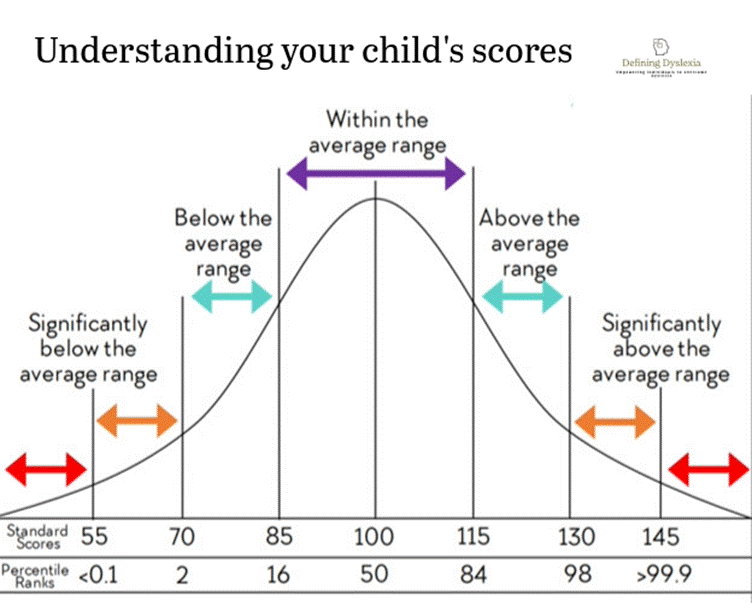
When you receive your child’s assessment report, you will see a series of scores alongside the areas that were tested. These are called standardised scores, and they can feel daunting at first glance. They are, in fact, a straightforward and very useful way of understanding how your child performed compared to other children of the same age.
Standardised scores are set so that 100 represents the average for any given age group. A score of 100 means your child performed at exactly the level expected for their age. Scores between 85 and 115 are considered within the average range, and this covers approximately two thirds of all children. Scores between 85 and 89 are described as low average, and scores between 111 and 115 as high average. Scores above 115 indicate above-average performance, and scores below 85 indicate an area where a child is finding things more challenging than most peers their age.
These scores are generated by comparing your child’s performance against a large representative group of children the same age, known as a standardisation sample. This makes the comparison fair and consistent regardless of which test is used or when it is taken.
It is important to understand that scores tell only part of the story. A good assessor will never interpret a score in isolation. They will look at patterns across all the areas tested, consider your child’s background and history, and weigh the scores alongside qualitative observations made during the assessment itself. A child who scores in the below-average range on one measure may score well above average on others. That pattern — sometimes called a spiky profile — can be just as informative as any individual score.
It is also worth knowing that scores can be affected by factors on the day, including anxiety, tiredness, or simply how a child is feeling. A skilled assessor will account for this and note anything that may have influenced the results.
The most important message is this: a score is a starting point, not a verdict. It provides useful evidenced information that helps everyone supporting your child to understand where to focus their efforts. Your child is always more than a number on a page.
18. What if the assessment does not identify dyslexia?
This is a question many families and adults carry quietly into the assessment process, and it is worth addressing honestly.
A dyslexia assessment is one of the most thorough explorations of how someone learns that they are ever likely to have. It looks carefully and in depth across a wide range of cognitive and literacy skills. That is true regardless of the outcome.
If the assessment does not identify dyslexia, that does not mean the process has been wasted. Far from it. The assessment will still have produced a detailed and nuanced picture of that individual’s strengths and difficulties. It will have identified where they are performing well and where they are finding things harder, and why. That information is genuinely valuable in its own right.
In many cases, an assessment that does not confirm dyslexia will still result in clear and useful signposting. It might point towards other specific learning differences such as ADHD, dyspraxia, or dyscalculia that warrant further exploration. It might highlight processing or memory difficulties that, while not meeting the threshold for a dyslexia diagnosis, are still meaningful and support-worthy. It might simply provide the first clear and detailed account of how that person’s mind works.
For many families, it is the first time anyone has looked that carefully and that thoroughly at their child’s needs. For many adults, it is the first time they have had a structured and evidenced explanation of experiences they have carried for years without answers.
Whatever the outcome, a good assessment is always a starting point rather than a final verdict. It opens a conversation, informs next steps, and gives everyone involved a clearer and more evidenced foundation to work from.
19. I have had a dyslexia report. Why is my child’s school saying they still need to check access arrangements?
This is a very common source of confusion, and it is worth understanding how the process works.
Access arrangements such as extra time, a reader, or a scribe in exams are governed by the Joint Council for Qualifications (JCQ). JCQ guidance is clear that access arrangements must be based on demonstrated need and normal way of working, not on a diagnosis alone. This means that even where a formal dyslexia assessment report exists, the school is required to trial and evidence that the arrangement is genuinely needed and regularly used by the student. A diagnosis opens the door, but the school must walk through it carefully and document what they find.
This can feel frustrating, but there is an important positive to take from it. A good assessment report does not just confirm a diagnosis. It tells the school precisely where to look. It identifies the specific areas of difficulty, whether that is reading speed, processing, working memory, or written output, giving the school a clear evidenced starting point for trialling and implementing the right arrangements.
This is also where the limitations of school-based screening become relevant again. A screener covers a broad but relatively shallow range of indicators and cannot always identify every area of difficulty. Without a full assessment, some students may not have their specific needs fully understood, meaning the right access arrangements may never be considered. A comprehensive assessment report removes that uncertainty and gives both the school and the student the clearest possible picture to work from.
20. Getting support without a formal diagnosis
A formal diagnosis is not a prerequisite for support. Schools in England are required to identify and respond to special educational needs under the SEND Code of Practice, regardless of whether a diagnosis is in place.
Where concerns are identified, schools should be working through a cycle of Assess, Plan, Do, Review (APDR), assessing the child’s needs, putting provision in place, implementing it, and reviewing its impact over time. This process does not require a formal diagnosis to begin and does not automatically mean a child will be placed on the SEN register. It does mean, however, that concerns should be formally identified, acted upon, and reviewed on a regular basis.
For families who are waiting for an assessment or unable to fund one immediately, asking the school to begin or continue the APDR cycle based on observed need is a practical and important first step.
21. Dyslexia assessment for adults
Many adults reach adulthood without ever having received a formal assessment. They may have developed coping strategies over the years but find that certain environments, such as higher education, a new job, or increased written demands, bring difficulties to the surface again.
A formal assessment as an adult can open doors to meaningful support. Employees can request reasonable adjustments under the Equality Act, and having a formal report provides the evidenced basis to do so confidently.
For university students, DSA funding may cover the cost of assessment, but it is important to understand that this is not a reimbursement scheme. You must first apply for and qualify for DSA, after which an assessment can be arranged through that funding. If you have already paid privately for an assessment before applying, DSA will not cover that cost retrospectively. It is worth contacting your university’s disability services team first to understand what options are available. Some universities can support the cost fully or in part, while others may signpost to independent routes.
It is also worth noting that some specialist assessors are able to identify and report on traits associated with ADHD or dyspraxia in adults aged 18 and over. This is not a medical diagnosis, and it is important to be clear about that distinction. However, a traits-based report can carry real practical value. It can support applications for reasonable adjustments at university or in the workplace, where the focus is on identified need and functional impact rather than a formal clinical label. Not all assessors offer this, so it is worth asking at the outset if this is relevant to your situation.
For adults outside of education or employment support schemes, an independent assessment with a qualified specialist is usually the most direct route. NHS provision for adult dyslexia assessment is very limited in most areas of England. Additionally, many adults simply find that having a clear explanation of how they process information is, in itself, enormously valuable.
The process for adults is broadly similar to that for children. A qualified specialist assessor will carry out a range of tasks and produce a report with findings and recommendations.
Can adults get a dyslexia assessment?
Yes. Adults can access an independent assessment directly by approaching a qualified assessor without a referral. University students should contact their disability services team first to understand what options are available. Some universities can support the cost fully or in part, while others may signpost to independent routes. It is always worth having that conversation before booking anything privately. Those in employment may be able to access support through Access to Work. Many adults find that a formal assessment, even later in life, provides clarity, opens doors to practical support, and is enormously valuable in its own right.
22. Final thoughts
Getting a dyslexia assessment can feel like a long road, but understanding your options is the first and most important step. Whether you are a parent advocating for your child or an adult seeking answers for yourself, routes do exist, and support is available at every stage of the journey.
It is also worth saying that once you have made the decision to pursue an independent assessment, the process itself is usually quite straightforward. You contact an assessor, have an initial conversation about your concerns, agree a date, and the assessment takes place, often within a matter of weeks. For many families and adults, the hardest part is knowing where to start, not the process itself.
The key is knowing where to look, what questions to ask, and who to turn to. We hope this guide helps you move forward with confidence.
Frequently Asked Questions
Do I need a GP referral for a dyslexia assessment?
No. You can approach an independent assessor directly without a GP referral. There is no waiting list, no referral form, and no permission needed. You simply contact an assessor, discuss your needs, and arrange an appointment at a time that works for you. It is also worth noting that dyslexia assessment is not available through the NHS Right to Choose scheme, and NHS-funded dyslexia assessment is very rarely available through other routes. This is largely because dyslexia is classified as a learning difficulty rather than a medical condition, meaning it falls outside the scope of NHS provision in most circumstances.
How long does a dyslexia assessment take?
A full assessment usually takes two to three hours. This includes a range of structured tasks covering reading, spelling, memory, processing speed, and other areas. Report turnaround varies by assessor but is typically one to three weeks after the assessment takes place.
What age can a child be assessed for dyslexia?
Most formal assessments are carried out from age eight upwards, when enough literacy development has taken place to assess meaningfully. In some cases, assessment may be considered from age seven where there is significant evidence of difficulty, for example where concerns have been formally documented over time and early intervention has not resolved them. If you have concerns about a younger child, it is worth speaking to the school SENCo and raising them formally so they are recorded and monitored.
What is a PATOSS assessor?
PATOSS is the Professional Association of Teachers of Students with Specific Learning Difficulties. A PATOSS-registered assessor holds a recognised Level 7 SpLD qualification and a current practising certificate, and adheres to professional standards in assessment practice. The British Dyslexia Association (BDA) and the Dyslexia Guild operate similar registration and quality assurance frameworks. What many families may not realise is that registered assessors are significantly regulated professionals. This involves ongoing CPD training to keep knowledge and practice current, professional registration and renewal, public liability insurance, and DBS checks. When you instruct a registered assessor, you are engaging a professional who is accountable to their registering body and committed to maintaining high standards of practice. Reports produced by assessors registered with any of these bodies are widely accepted for education, university, and employment purposes.
Sources and further information
The following organisations provide reliable and up-to-date information on dyslexia, assessment, and related support:
- PATOSS — the Professional Association of Teachers of Students with Specific Learning Difficulties, including a directory of registered assessors. patoss.org.uk
- British Dyslexia Association — the leading charity for dyslexia in the UK, offering guidance for families, adults, and professionals. bda-dyslexia.org.uk
- Dyslexia Guild — a professional membership organisation for specialist teachers and assessors. dyslexiaguild.org.uk
- Helen Arkell Dyslexia Charity — specialist support, training, and assessment services, including bursary funding for families who need financial assistance. helenarkell.org.uk
- IPSEA — independent advice and support on special educational needs and the law, including EHCP rights. ipsea.org.uk
- Council for Disabled Children — national information and resources for families of disabled children and young people. councilfordisabledchildren.org.uk
- SEND Code of Practice — the statutory guidance on supporting children and young people with special educational needs and disabilities. Available at gov.uk
- Equality Act 2010 — the legislation covering reasonable adjustments in education and employment. Available at legislation.gov.uk
- Access to Work — government support for disabled people in employment, including assessment funding. Available at gov.uk
- My Family Our Needs — support, information, and community for families of children and young people with additional needs. myfamilyourneeds.co.uk

Mark Wilson is a PATOSS-registered specialist teacher and dyslexia assessor with fifteen years of experience in SpLD assessment and education. Mark runs Defining Dyslexia, an independent assessment and consultancy practice offering both in-person and remote assessments across the UK, with face-to-face services available in Sheffield, South Yorkshire, Peterborough, and Cambridgeshire. Visit definingdyslexia.org to find out more.
This article is intended as general guidance only and does not constitute professional advice. Provider availability, costs, and policy details can change. Always check current information with relevant organisations.