
14th September 2023 • My Family Our Needs
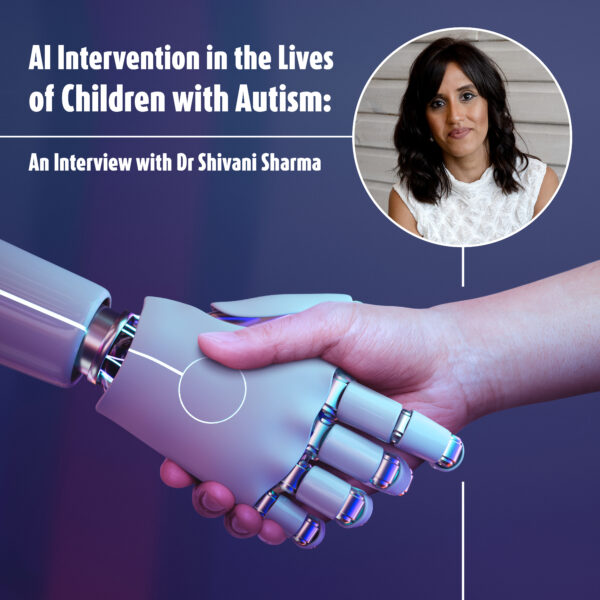
In this interview, we introduce Dr Shivani Sharma who is Head of the Department of Psychology, Sport and Geography at the University of Hertfordshire.
We asked Dr Sharma about the role of Artificial Intelligence (AI) in aiding autistic children. She spoke to us about how AI can drive early diagnosis, create personalised learning plans and more.
Autism and AI
When we talk about AI, Dr Sharma told us, we are talking about the ability of software and machines to be able to replicate and mimic aspects of human function. As such, she stressed that AI is rapidly evolving and its potential is not yet fully understood. However, two particular areas where the capabilities of AI are being studied in relation to autism stand out.
One is within the diagnosis process and how AI can make this a smoother, more efficient process for parents and children alike. Dr Sharma told us that AI is able to look for patterns of behaviour and use this as a way for clinicians to reach decisions faster based on the evidence they have. Currently, diagnosis for autism is behaviourally based on expert opinion, but how these AI based tools might be able to support or expedite this process is being explored.
The second area, Shivani explained, is support for families and children once a diagnosis is determined. In her own work, she has explored using AI enabled tools to support everyday learning for autistic individuals to live life to their fullest potential, as independently as possible. Overall, Shivani said that whilst the potential of AI to enhance the lives of autistic individuals is there, its everyday implementation remains limited due to gaps in research.
Robots and Research
Dr Sharma told us that the use of technology to support learning in autism is becoming popular as lots of evidence suggests that autistic children are drawn to technology. Many attributes of technology may appeal to autistic individuals such as predictability and structure, making technology easier to interact with.
In her own work, Shivani looks at the use of robots with autistic children and how humanoid robots can accelerate learning in young children in particular. This is because a humanoid robot is typically designed to have some simple human-like features, whilst being minimally expressive. The robot can be programmed to play a series of games based on teaching and creating environments to practice different age appropriate social skills such as turn taking. By reducing the need to do multiple things at once, for example, processing facial expressions, autistic children can focus on learning the skill they are working on.
Dr Sharma explained that robots can be used as a tool to help children stay engaged for longer and hold their attention, bridging the gap between adults or other children as play partners and the child too. Evidence suggests that robots can help autistic children with different things like teaching motor skills, interaction skills and aspects of the curriculum.
The other way AI is being explored for intervention is within classroom interactions. Shivani explained that interactions and behaviours in a classroom setting, for example, can be coded, allowing teachers to choose what way of teaching might work best for individual children, for example, using picture aids. Teachers can do this by analysing patterns in the way that children have responded across a range of situations. This kind of research in everyday settings is also underway. Whilst not yet mainstream, the possibility of implementing a range of AI enabled approaches to support learning and development is there.
Kaspar at the University of Hertfordshire
Similarly, Dr Sharma told us more about the University of Hertfordshire’s own robot, Kaspar, a minimally expressive humanoid robot intentionally designed for use in a therapeutic setting. It is intended to allow children not to have to worry about environmental factors and breaks down interactions into chunks, like turn taking and acceptability of social space. The robot can be programmed to support the skills and development of children who are able to personalise and choose their learning, currently with support of an adult play partner. Developed researchers in Computer Science, Shivani’s interest has been in extending research evidence on the impact of Kaspar in learning situations, recognising that evidence is a pathway to more children accessing support.
Working Alongside Parents
When discussing the challenges of implementing AI solutions for autism support, Shivani noted that parents, practitioners, and educators are all gatekeepers to technology. For parents, it can be difficult to navigate what is real and fake news, and what has real evidence behind it. She stressed that to ensure widespread scalability, scientists must work with those using and implementing interventions and make sure everyone is part of development and evaluation. This can also help raise awareness in everyday language about what the evidence base is, what is means and why it matters.
Co-production with parents and children directly is something that Dr Sharma and collaborators are taking particular care with. She also emphasised the importance of health equity and the need for something scalable. Shivani explained that interventions such as Kaspar would ideally be freely available from the point of NHS diagnosis. She has been working with a team of researchers, including Computer Scientists, to explore how feasible this might be in everyday autism clinic settings in England.
Technology and the Transition to Adulthood
In terms of promoting greater independence and self-sufficiency among autistic youth as they transition to adulthood, Dr Sharma explained that robots can be transferred across different types of settings. For example, keeping the same robot but increasing the complexity of social skills being supported across new settings. In this way, youth will be familiar with the technology to enhance their learning experience. Shivani explained that the use of AI enabled data capture and selection of teaching strategies she mentioned might be useful in transition settings too for teachers to share helpful information with each other about a child and their ways of responding and learning. This may allow for the tailoring of behavioural and learning strategies. Additionally, already robots are being used for socially assisted living in wider settings, giving promise to help with emotions such as loneliness, as well as everyday skills and more.
Collaborative Intervention
When discussing collaboration between researchers and developers and autistic individuals and their families further, Dr Sharma stressed that the Kaspar robot at the university has collaboration at its heart from both Computer Scientists in developing the technology, and Psychologists working on its evaluation. At the moment, Shivani mentioned that the team are working on a survey of parents and their preferences for technology to involve the gatekeeper. Shivani explained that her team found that awareness of things like AI tools is low whilst scepticism is high, therefore the research community need to work closely with children and families to demystify and explain what AI enabled autism intervention means and to imagine together what this could ‘look like’.
Tailoring Technology
Moving forward, tailoring AI support for children from different backgrounds and social demographics must be considered. Dr Sharma noted that usually, research benefits a small cluster of young people, with much larger potential to be scalable. The more personalisation, the more social disparity and social inequity can be addressed. Though, Shivani noted that when taking these approaches internationally or more widely across multi-cultural settings, researchers need to think carefully about acceptability in different communities and benefitting those on the receiving end of support. For example, in relation to her own work, it may be that language adaptation is needed, and/or the nature of games that Kaspar plays with children.
What Can Parents Do?
Considering the role of parents in guiding their children through the process of adapting to AI, Dr Sharma noted that we must be aware that technological solutions are not for everyone. However, she believes that the starting point for parents is to understand the evidence for the type of interventions out there. Shivani explained that the clinical and research community must work with parents to spread awareness of the range of evidence-based interventions available. Then, parents have every opportunity to decide in collaboration with their child.
She encourages parents to be curious and ask questions. She hopes that researchers like her will continue to support parents in this regard, making sure that science is developed with, and works for the stakeholders it is designed to support and for that specific purpose.
Dr Sharma noted that parents can find out more about the developments in AI through primary sources of research, as well as blogs where practitioners, teachers and researchers share their experiences and latest developments. She finished by saying that most people tend to have heard about AI and may have either firm or vague ideas about what it is and how it might help in their personal context. She told us, if you’re curious as a parent, look for information, go for credible sources where research is going to be a key part, and read mindfully what you see in all spaces.

Dr Shivani Sharma is Head of the Department of Psychology, Sport, and Geography at the University of Hertfordshire. She is an advocate for making health and psychological care equitable and accessible for all, regardless of disadvantages arising from factors such as ethnicity, economic means, gender, disability, or language.
Her research on health inequalities, especially how they relate to the experiences and outcomes of people with one or more protected characteristics, aims to re-imagine how care is planned and delivered, including for autistic youth and adults.
Twitter @_ShivaniSharma I LinkedIn dr-shivani-sharma-verma