18th April 2024 • My Family Our Needs
In the first instalment of our National Pet Month 2024 series, we sat down with Barbara Vokatis to shed light on the invaluable contributions of therapy animals in bridging educational gaps.
With a vision to incorporate therapy animals in the classroom and spread the word about their transformative capabilities, Barbara talked about how she and her dog are enhancing learning, fostering empathy and supporting SEND children.
1. What inspired you to work on the use of therapy animals with children? Can you talk to us about Carmel?
Working with children was always my interest. I’ve been an educator in this field for 30 years. My daughter was diagnosed as autistic over 10 years ago and I saw how she and other autistic and SEND children struggled in school. So, I began thinking, how much can a teacher or psychologist really help children? They’re certainly valuable but I started seeing, with my daughter and with other children in school, that it was not enough. Something was missing that could help create a better climate and a fuller picture of support for children, with the help of teachers and psychologists.
We purchased our dog when my daughter was 10 and the interactions were so beneficial for her. So, I certified my dog as a therapy dog so we could visit schools. It wasn’t a quick journey but we achieved it. I started going to my daughter’s school and I saw some incredible benefits and spoke to the teachers who shared many positives they’ve seen for the children based on our therapy visits. Recently, as we’re innovating in this area, we’ve seen even more.
‘When you introduce a therapy animal, whether that’s a dog or another animal, it helps create a classroom climate where children are better at interacting with others’.
2. Can you share some specific examples or anecdotes that highlight the positive impact and any long-term benefits therapy animals have had on children with additional needs?
There are benefits for the whole classroom of students. It doesn’t matter if you have SEND students or neurotypical students. When you introduce a therapy animal, whether that’s a dog or another animal, it helps create a classroom climate where children are better at interacting with others. We want to see inclusivity but it’s not always easy to do this.
It turns out that animals have an incredible power to assist in that. If you do more innovative activities with them, if you can connect for example, learning about and teaching kindness compared to how a dog is kind, then children can learn about any concept from the dog. They are so immersed and they can compare it to their situation. Learning through application by connecting with the dog makes such a big difference. Children started working together where they didn’t previously.
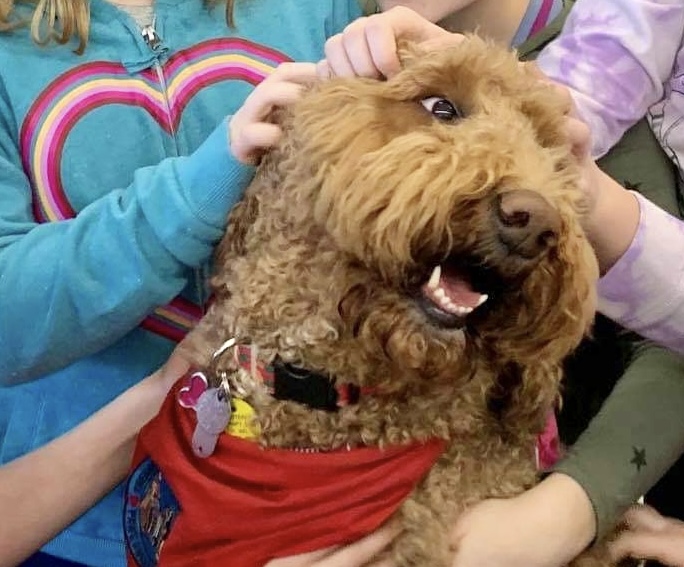
We had situations when a child did not speak at all in school which was difficult for the teacher. I visited with my dog and I wasn’t aware of this at all. Carmel gently touched this student with her nose and he just started laughing. Therapy dogs and therapy animals bring a lot of fun and joy so that’s another incredible aspect. He said something along the lines of ‘This is so cool, I love you so much, Carmel’. That was the first time the teacher heard this child speaking and that was a groundbreaking moment for him. You can only imagine in every school in the world, there is at least one if not more children who don’t talk at all and you have a teacher who can be an awesome teacher but there is no way of connecting to the child as well as the animal can do it.
We also work with a group of students who are very weak at math but they come to the group and just enjoy the activity because we make it fun. There is movement and elements of a game and my dog turns into a math checker for them and suddenly they don’t seem weak at all. It’s what you can achieve when you include therapy animals in some more innovative ways but these are not necessarily complicated ways at all.
3. How do therapy animals contribute to the emotional and social development of children in educational settings?
I remember one time, there was a theme of kindness occurring in the school. Together, we asked how Carmel shows that she’s a kind dog. They all wanted to participate in answering the question because it’s about the dog that they love to see. That was only once a week, but it still created an impact. We then said, ‘Now you’ve learnt a lot from Carmel about kindness, how can you show kindness to other people in your life, in school, to your peers and to your family?’. Of course, we must understand that dogs might act a little bit differently because they are dogs. We talk about these differences as well. So again, everybody wants to participate and talk about how they can show kindness to others based on what they learned from Carmel. You get the participation in this social, emotional learning experience because of the dog.
Another time, a teacher told me the class was talking about me and Carmel and discussing how they must learn to be more patient because Carmel is a very patient dog. They talked about learning as something that doesn’t come from the teacher explicitly but they see what they need to learn because they see that their dog already has learned this. It’s emotional and you see the power of bringing the dog even if it’s just once a week. It just depends on the willingness of the school and their understanding of this power.
‘An interaction with an animal who is non-judgmental can help children feel more secure, more safe and more willing to participate’.
4. It sounds like Carmel is acting as a role model to the children.
Yes, she does. If we want to improve education, we cannot do it without considering these interactions. I think that it’s foolish to believe that we can educate by only providing the best teachers, the best supposedly curricula and that is it. The classroom may still feel cold and unwelcoming for the child and it causes anxiety in children. Sometimes people are not enough to break the anxiety. An interaction with an animal who is non-judgmental can help children feel more secure, more safe and more willing to participate.
5. How can therapy animals be included to support children with specific conditions like autism, ADHD or emotional disorders? Can they help with sensory overload and stress?
Some children love to touch Carmel in ways that other kids maybe don’t. Others pet her gently but others like to play a little bit more with her curls, feeling them and talking about it. I can see that they have sensory issues and it’s making them calmer. I know that many children with autism do have sensory issues so this can be incredibly beneficial depending on what they like to touch and feel. Of course, I am observing to make sure that Carmel is happy with this type of interaction too. I am there as an advocate, not just for children, but also for my dog to make sure that everybody enjoys the interactions and they are safe and accepted.
6. Are there any misconceptions or myths about therapy animals that you would like to address?
A common misconception that prevents some schools from introducing this practice is children with allergies but there are ways to mitigate these situations. Finding out the severity, what kind of allergy that is and so on. Maybe the child cannot touch the dog but can observe the interactions with the dog. There are ways of including everyone, but it just needs to be communicated.
An incredible organisation that is becoming a leader in the field is the Association of Animal Assisted Intervention Professionals (AAAIP). They provide training and informational sessions for teachers and administrators.
In the United States, educators face pressures around what to teach and their curriculum. Sometimes they have to teach in a way that’s prescribed and don’t have a lot of freedom. They may perhaps think the therapy dog is going to be a distraction that will prevent them from teaching. Then again, if we are willing to learn a little bit more about this and find out the benefits, we’ll find that we’ll be able to teach in more powerful ways with more motivation and engagement from the children. Isn’t that what we want as teachers?
7. What advice would you give to parents and educators on how to best incorporate therapy animal interactions into their lives? What are the benefits of involving the family and how can we support our child’s experiences?
When these things are introduced correctly, professionally and safely by the school, a letter from the school would be sent describing the programme of therapy dog visits and the organisation with clear certifications asking for parents’ consent.
Then the parent should really seek some more information from the school about what is happening, what kind of therapy dog team it is and what their credentials are to make sure that this is done professionally.
‘Interacting with a dog in school is a highlight for every child. No matter what, the parent will hear about it from the child…’
8. How do I know if my child is responding positively to therapy animal interactions, and what signs should I look for?
Interacting with a dog in school is a highlight for every child. No matter what, the parent will hear about it from the child who will talk and express their feelings about it. As parents, we can ask more questions, like, ‘What exactly are you doing in the classroom with the dog?’, ‘How do you like it?’, or ‘What kind of dog is it?’.
You can extend it further as a social and emotional learning opportunity at home. Again, ask what the dog does or how they act to get some more information from your child. Talking about how the therapy dog works hard in training to visit schools is a very natural, organic way of reinforcing some ideas about putting in effort and working hard. When children need to do their school work and homework, there’s this connection of determination.
It wouldn’t hurt if parents found out more information about therapy dogs, their benefits and what they do for children. That will create even more opportunities for these conversations with children.
9. What future trends or developments do you foresee in the use of therapy animals in education?
Right now, therapy animals can help and are helping in any school setting.
Many schools have never seen a therapy dog but they can be very helpful with speech therapy, physical therapy and for children with autism, ADHD and other needs.
I’m trying to push forward with adding some more activities in which the dog becomes a little bit more than a visiting therapy dog and team. For instance, when children in our math group do calculations, in one of the activities they come to see my dog and ask her if they’re correct and my dog usually sits down, wags her tail or sniffs their paper. The children get excited and thank Carmel for her encouragement and they are so fired up to go and do another math fact. My dog becomes a teaching assistant.
It’s an activity that truly can revolutionise the way we teach. With math, it’s not just math anymore, but it becomes movement and entertainment too, with the therapy dog as a math learning assistant. By the end of this half-hour session, everybody’s asking where the time went. Everyone is so entertained, laughing, learning and everybody’s happy.
10. Is there anything else you’d like to tell us?
I think that there are some incredible initiatives happening in this field by some organisations such as AAAIP to unify this field and provide standards so we don’t have misconceptions that allow us to create plans that schools can implement.
What I think we need, and that is my request for readers, is to educate ourselves more about this, spread awareness and share this conversation on social media, with other parents, with teachers and with educational institutions.
The work we do is a result of the willingness of others to share and spread awareness. It’s not going to happen on its own. We need advocacy and we need ways of sharing this information with others to find ways for this to get into schools, systems and to teachers and administrators.
If parents know just how much this can help their children, they will be demanding educational institutions to do it.

Barbara is an educator with international experience in the field. Currently, she is an associate professor at SUNY Oneonta. She has been volunteering with her golden doodle Carmel in educational settings for six years and innovating in the area of animal-assisted education. Her latest book, ‘Teachers and therapy dog teams: Innovative collaborations to make a difference for children’, describes the innovation. In addition, she is an author of an award-winning children’s book ‘Carmel goes to school’. Barbara is also a member of Association of Animal – Assisted Intervention Professionals (AAAIP).