
30th April 2024 • My Family Our Needs
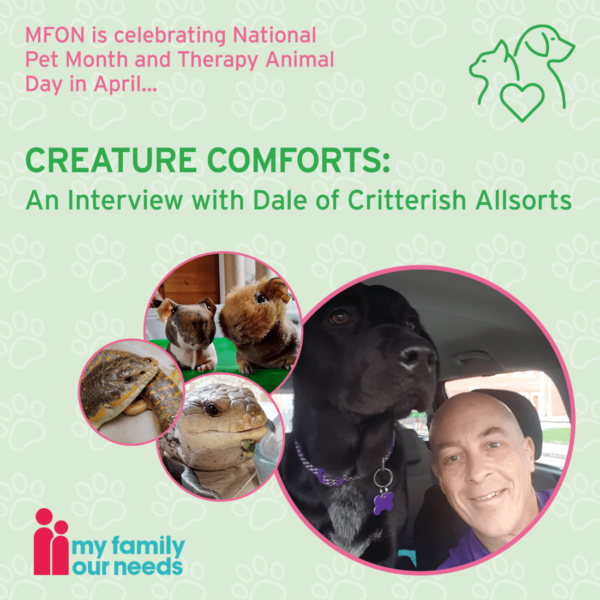
For the final instalment in our National Pet Month 2024 series and to celebrate Therapy Animal Day, we spoke to Dale Preece-Kelly at Critterish Allsorts about the bonds that can be forged with animal friends.
From thwarting fears to processing thoughts, Dale told us about his hopes for the expansion of animal-assisted therapy to improve people’s lives in so many sectors.
1. Can you tell us about the services offered by Critterish Allsorts and what type of animals you work with and why?
I work primarily in the prison industry but also in psychiatric hospitals, care homes and schools, particularly with SEND kids.
We were established in 2010 when my primary aim was to work in education. I started by advertising on Facebook and did 45-minute meet and greets with parents over the summer holidays. We did the NEC in 2011 and I met a couple of teachers from a psychiatric hospital in Birmingham who invited me to a garden party. Right there, we recognised that the animals were making a difference to people and that’s where it’s all developed from.
As for the animals we work with, I’ve got a dog, a cat, snakes, lizards, ferrets, a chinchilla, guinea pigs, rabbits, spiders, millipedes, stick insects, frogs, tortoises – a bit of everything. They’re all rescue animals and they’ve all got their own story to tell. It’s good when you’re working in psych hospitals and prisons as the people and the animals have been through similar things which builds relationships.
The other beauty of having all the animals is it’s inclusive. We’ve got hypo-allergenic skinny pigs and chinchillas and so much more than just furries and mammals. People are more into their exotic animals now. I take a selection of animals so everyone’s got a chance to engage and I think that that makes the difference.
2. How do therapy animals contribute to mental health and emotional wellbeing?
The initial thing is a smile but then you get the release of the endorphins, oxytocin and serotonin. With some of the more obscure animals like snakes and spiders, you also get a dopamine and adrenaline rush because you’re doing something a bit risky. When you’re handling a bird-eating tarantula or a nine-foot boa constrictor that weighs 5 stone, you go through a rollercoaster of emotions but people calm down and start to enjoy the thrill and the calm that follows.
The way the media portrays snakes, spiders and all that sort of thing puts people off. Once people realise that they’re fine with the animals, there’s an inner feeling of peace and happiness, whether they’re furry or not.
Everyone’s got their own animal. I go into places regularly and a lot of guys that meet my animals develop a bond. To them, it’s their animal, I’m looking after it. It’s the same for patients, prisoners and staff alike. In a lot of the prisons I visit, we’ll do the sessions with the prisoners during the day and at lunchtime they have a staff session so the staff can not only get an idea of what the therapy is for and about, but they also get the therapy. It’s a good way for them to de-stress and get over their day.
‘It’s amazing to see somebody get over a phobia. It does great things for self-esteem and confidence’.
3. In what ways does Critter Assisted Therapy tailor its programs to provide sessions for children with additional needs within a supportive and non-judgemental environment and have you received any feedback?
Everybody’s different. If I’ve got a group of SEND kids, then I will run workshops. We do this thing called ‘Create a Critter’ where I take in seven or eight animals and I tell the kids all about them and what their best part is or superpower is. Then I get them to draw the part of each animal they think is the best part. They might put together a chinchilla’s ears and whiskers, a lizard’s legs and a hedgehog’s spikes and they end up with this animal they’ve created that’s unique to them and they give it a name. They can write a poem about it, colour it in and write down all the superpowers that animal has in their eyes. We end up with some fantastic creations.
Usually, it’s in a setting with six or seven families. It allows the parents to appreciate their kids from a different perspective. Most of them are dealing with life day-to-day which can be probably quite stressful. By doing something like this, they’re seeing where their kids excel. I believe that autistic children are geniuses in a lot of ways. They are so clever and if you find their unique passion and then exploit that passion, they will excel. The most common feedback I get from parents is, ‘Thank you, you made my child happy’.
Everything I do is unique to the person. When I’m working 1:1 with someone I’ll do a basic session to start with just so I can get a feel for the person and then we tailor future sessions to suit that person’s needs. One lad I worked with was heavily into mechanical, working parts, so we worked with spiders who have a system of hydraulics in their legs. Every session had something to do with that passion.
4. What advice would you give to parents or caregivers interested in exploring therapy animal sessions for their child with additional needs?
1:1 sessions or very small groups are probably better. Because of the way autism works, group sessions will be a little bit overwhelming for autistic kids.
Make sure that the person leading the sessions has experience working with autistic people and they understand autism. You also need to ensure they’re qualified as a practitioner. Similarly, if you book an animal service, make it clear what your child’s needs are so everyone can come in prepared.
I’m working with a nonverbal lady at the moment and her mum explained her needs beforehand. Before I go, I can set my expectations, know how she will respond and know what to look for to see that she’s enjoying it and I can just provide a running commentary of what the animals are doing.
‘It’s good for people to understand animals and not be scared of them because there’s no need to be. We can learn so much from them. You just have to know how they think’.
I find a lot of parents will want to get their children a pet when they see me. They need to do their research. Look into the pet and make sure it fits your family’s lifestyle. Remember that when you get a pet for a child, you’re actually getting a pet for yourself because you’re going to do most of the work.
I rehome a lot of a lot of animals that have been bought as pets and they can’t be coped with or have become boring because they’ve lived too long. It’s all about getting parents to research and think about the bigger picture, not just narrowly.
Some parents who have children with severe needs have a carer’s allowance. They can look at what they can use their carer’s allowance for and perhaps it can aid with the costs of animal therapy.
5. What are some misconceptions about therapy animals that you’d like to clarify?
A lot of people think everything is like the movies. A common misconception is that snakes eat people, they strike easily and they’re evil. People will say, ‘The snake’s looking at me’, but snakes can’t see because their vision is abysmal. Real-life snakes are quite pleasant animals. They’re very laid back and a good reflection of someone’s energy.
I introduced one to a snake-loving inmate as a challenge and despite it biting me whenever I handled it, he managed to calm it down effortlessly. Through our work together, he learned that by staying calm, the animal will stay calm which he’ll take forward when he’s released.
When we’re working with phobias, we try desensitisation or exposure therapy.
My friend’s daughter, a photographer who was terrified of spiders, overcame her fear when I placed my tarantula in front of her camera. She bravely took close-up photos and eventually learned to handle spiders gently, no longer fearing or harming them, thanks to understanding their behaviour and psychology that I explained to her.
It’s amazing to see somebody get over a phobia. It does great things for self-esteem and confidence. It’s not just for me to see that change but for the parents too and for it to be lasting after the therapy is finished.
It’s good for people to understand animals and not be scared of them because there’s no need to be. We can learn so much from them. You just have to know how they think.
‘I think animals allow that freedom in your own time and space without having to interact with anybody else’.
6. What future plans or initiatives do you have for expanding the impact of pet therapy in the community?
The aim of the business is to try and make it so that there is an animal-assisted therapy practitioner in every doctor’s practice in the country, in every hospital, in every psych hospital. I’d put myself out of business for it to become a mainstream alternative therapy and prescribed treatment. At the moment it’s still seen as unconventional because you’re doing something that can’t be explained scientifically.
I know it works because I’ve given myself animal-assisted therapy. When my partner passed away in 2017 and when my most recent partner left, the animals helped me through. Within six weeks, I was through the other side – I was living my life again. It might have something to do with my personality but I think it would save a lot of people being prescribed medication and clear a few spaces in hospitals. It would give people a chance to come to terms with their grief and thoughts in the presence of something that’s not expecting an answer to an awkward question. They can sit and chat with the animals who listen but don’t criticise. It’s a therapeutic environment.
My sessions are always informal. We laugh, we smile and we have philosophical conversations about life. It’s a change in persona and mindset that helps people come to terms with their thought process and allows them to move forward. I think animals allow that freedom in your own time and space without having to interact with anybody else. Some people come to my sessions and will just interact with animals and won’t say a word to anybody. I’m quite happy with that. As long as they leave with a smile on their face, they’ve enjoyed it and they’re happy, I’ve done my job.

Critterish Allsorts – Dale Preece-Kelly
Critterish Allsorts was established in 2010 following some health issues Dale was suffering. In 2011, the company began to work in medium secure psychiatric facilities, focusing on the human-animal connection to aid with mental health issues. Thus, Critter Assisted Therapy became the online identity for the company to show Dale’s commitment to Animal Assisted Therapy.
The services have since gone from strength to strength with the services being utilised in prisons from 2017. Dale is seen worldwide as a pioneer in the field and features regularly on TV shows and has also been seen in newspapers and magazines.
The Critterish Allsorts podcast, ‘Critterish Chatter’ launched on Spotify in March 2024 and more can be discovered via Dale’s book on Amazon ‘Unleashing the Healing Power of Animals’, which is also the business’ tagline.